
How to calculate generator wattage for home appliances

Introduction
Calculating the correct generator wattage is a critical step for any homeowner in the Dominican Republic looking to ensure energy security during power outages or hurricane seasons. Knowing exactly how much power your household requires prevents the common mistake of purchasing an undersized unit that stalls under load or an oversized unit that wastes fuel and money. This process involves understanding the specific energy demands of your appliances and how they behave when they first turn on.
By mastering this calculation, you can create a reliable backup plan that keeps essential items like refrigerators, fans, and lights running smoothly. Instead of relying on guesswork, which can lead to equipment damage or prolonged darkness, a methodical approach allows you to invest in hardware that matches your actual lifestyle and necessity. This guide provides a structured method to determine your home's wattage needs accurately.
Understanding running watts versus starting watts
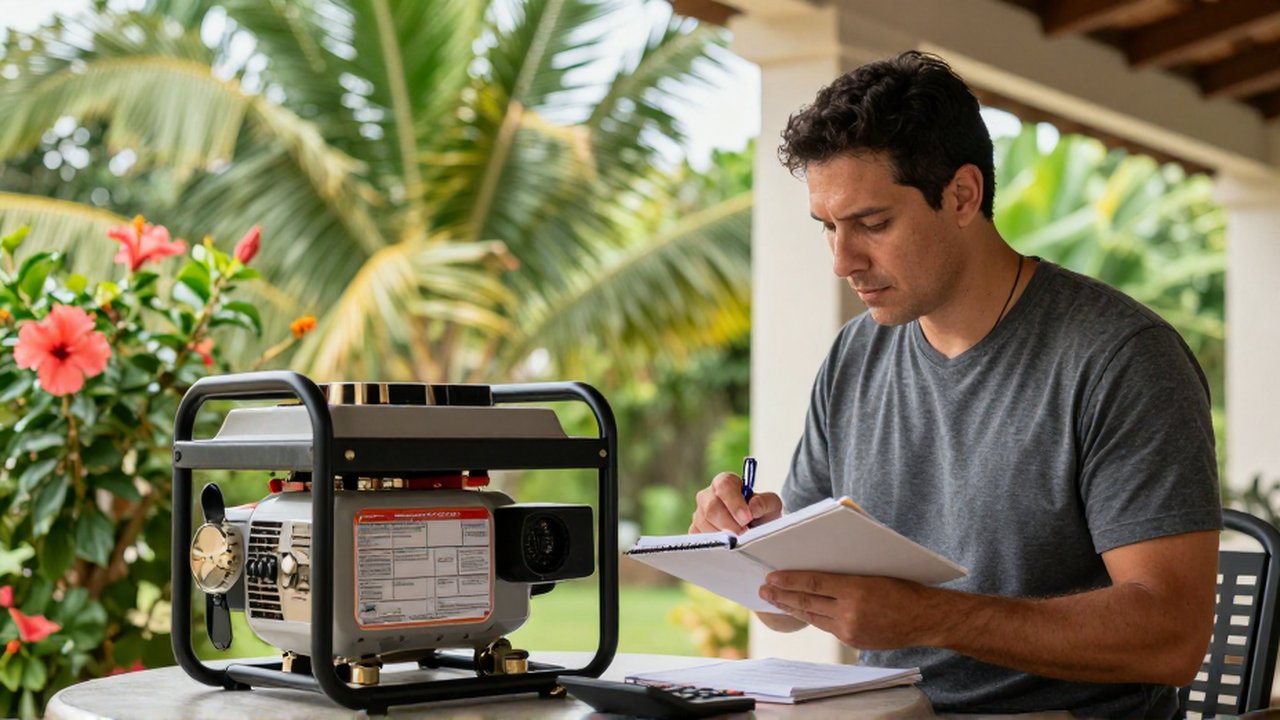
To calculate your needs correctly, you must differentiate between two types of power consumption: running watts and starting watts. Running watts, also known as rated watts, represent the continuous amount of electricity an appliance uses to maintain its operation. For example, a LED bulb uses a consistent, low amount of wattage while it is lit.
Starting watts, or surge watts, are significantly higher and occur the moment an appliance with a motor or compressor kicks in. Devices like air conditioners, refrigerators, and water pumps require a massive burst of energy to overcome inertia and start their internal components. If you only calculate based on running watts, your generator will likely fail or trip its circuit breaker the moment a large appliance attempts to start. A safe rule of thumb is to identify the running wattage for everything you want to power and then account for the highest surge wattage among your motorized appliances.
Steps to audit your home electrical needs
The most effective way to determine your total requirement is to perform a manual audit of your home. Begin by creating a list of every appliance you intend to run during a power outage. Categorize these into "essential" (refrigerators, lights, internet routers, small fans) and "non-essential" (air conditioning, electric stoves, large washing machines).
For each item on your list, locate the manufacturer's label, usually found on the back or bottom of the device. This label will list the wattage (W). If the label only provides Amperes (A), you can calculate the watts by multiplying the Amperes by the Volts (typically 110V or 220V in the Dominican Republic). Once you have the wattage for every item, use the following process:
- Sum the running watts of all essential appliances.
- Identify the appliance with the highest starting wattage requirement.
- Add that single highest starting wattage value to your total running wattage sum.
- Add a safety margin of 20% to the final total to prevent the generator from running at its absolute maximum capacity constantly.
Practical examples of wattage calculations

To visualize this, consider a small household scenario. Suppose you want to power a refrigerator (600W running / 1200W starting), five LED bulbs (50W total), a Wi-Fi router (20W), and a ceiling fan (75W).
In this case, you do not add all the starting watts together, as they rarely all kick in at the exact same millisecond. Instead, you sum the running watts of everything: 600 + 50 + 20 + 75 = 745W. Then, you look for the highest surge, which is the refrigerator at an additional 600W (the difference between its 1200W start and 600W run). Your total requirement is 1345W. Adding a 20% safety margin (roughly 269W) brings your target generator size to approximately 1614W.
If you decide to add an air conditioning unit to this list, the calculation changes drastically. An air conditioner might use 1500W while running but require 3500W to start. Your generator would need to be significantly larger to accommodate that specific surge.
Common mistakes in generator sizing
One frequent error is the "additive surge" mistake, where users add the starting watts of every single appliance together. This results in an unnecessarily large and expensive generator. In reality, peak loads are transient; you only need to ensure the generator can handle the largest single surge occurring at any one time.
Another mistake is ignoring the total load capacity of the generator's outlets. Even if a generator has enough total wattage, you must ensure the distribution of that power through your extension cords and breakers is safe. Overloading a single circuit while the generator has plenty of total power can still lead to local failures. Finally, failing to account for the "safety margin" is a risk. Running a generator at 100% capacity for extended periods increases wear and tear and can lead to overheating.
Frequently asked questions
Can I run my whole house on one generator? Yes, but this requires a much larger, often industrial-sized generator and a professional transfer switch installation. For most residential backup plans, it is more cost-effective to focus on essential circuits.
Does voltage affect the wattage calculation? Yes. In the Dominican Republic, you will deal with both 110V and 220V. Ensure your appliances and your generator are compatible with the voltage of your home's circuits to avoid damage or inefficient power usage.
How often should I check my generator capacity? You should re-evaluate your needs whenever you purchase a new major appliance, such as a new refrigerator or air conditioner, as these will change your total wattage requirements.
Is it better to have a larger generator than I need? Generally, yes. Having a generator with more capacity than your calculated need allows for more flexibility and ensures the engine is not constantly strained, which improves longevity and fuel efficiency.
Leave a Reply