
Best ways to hang heavy mirrors on walls

Introduction
Hanging a heavy mirror is a transformative home improvement task that can instantly add depth, light, and a sense of luxury to any room. Whether it is a large floor-length leaning mirror or a massive framed piece intended for a centerpiece display, getting the installation right is crucial for both aesthetics and safety. A properly mounted mirror serves as a functional tool and a sophisticated decor element that elevates the visual impact of your living space.
However, the weight and fragility of glass make this task more complex than hanging standard artwork. Attempting to use insufficient hardware or failing to account for wall composition can lead to catastrophic damage, including cracked glass or structural failure of the drywall. Understanding the relationship between the mirror's weight, the type of wall you are working with, and the appropriate mechanical fasteners is essential for a secure and permanent installation.
Knowing the right techniques ensures that your investment remains safely displayed for years to years. This guide provides a comprehensive look at the most reliable methods to secure heavy mirrors, helping you choose the right approach based on your specific home environment and the structural requirements of your walls.
Essential tools and preparation
Before beginning any installation, you must conduct a thorough assessment of both the mirror and the wall. The most critical step is determining the exact weight of the mirror. Use a reliable scale to find the weight, as many manufacturers provide estimates that may not account for heavy, ornate frames. Once you have the weight, you can select hardware that is rated for a capacity significantly higher than the mirror itself to provide a safety margin.
You will also need to identify your wall type. In many modern homes, you will encounter drywall (plasterboard), which provides little structural support on its own. In older constructions or specific areas, you may encounter solid masonry or wood. Knowing where the internal wooden studs are located is the most effective way to ensure a heavy object remains secure. You can use a stud finder to locate these vertical supports, which offer the strongest anchoring points.
Gathering the right tools is equally important. Beyond a hammer or a drill, you will likely need a level to ensure the mirror is perfectly straight, a measuring tape for precision, a pencil for marking, and potentially a stud finder and masonry bits if dealing with concrete or brick. Preparing the workspace by clearing the area around the intended hanging spot will also prevent accidents during the lifting process.
Hanging on drywall using studs
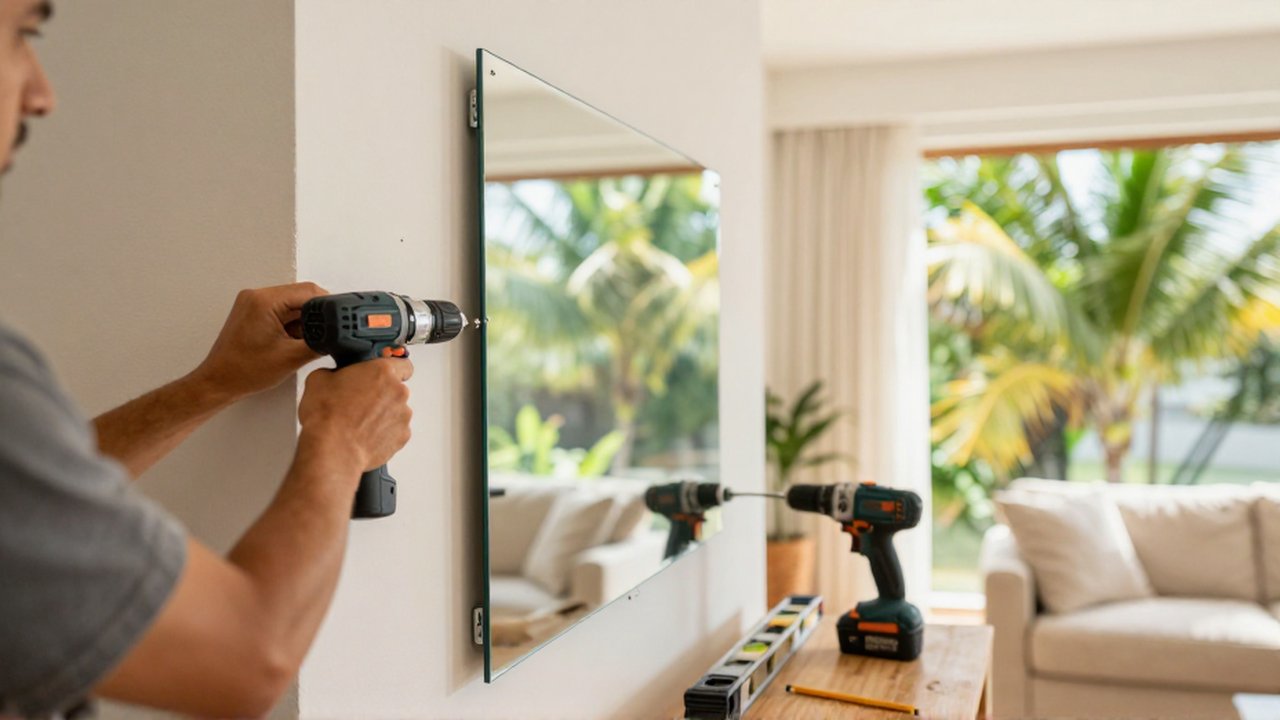
The most secure way to hang a heavy mirror on a drywall surface is to anchor it directly into the wooden studs located behind the wall. Because studs are structural members of the house, they can bear significant weight without the risk of the drywall tearing or crumbling.
To execute this, use a stud finder to locate the center of the stud. Once located, mark the spot clearly with a pencil. You will then need to drill a pilot hole to prevent the wood from splitting and then drive a heavy-duty screw through your mounting hardware into the stud. If the mirror uses a wire hanging system, ensure the wire is rated for the weight and that the hanging points on the mirror frame are sufficiently strong to handle the tension.
If the mirror's mounting points do not align perfectly with the existing studs, you may need to use a combination of anchoring methods. In such cases, securing at least one side of the mirror to a stud provides the primary stability, while high-quality heavy-duty anchors can support the remaining weight on the drywall itself.
Using heavy duty anchors for non-stud areas
When you cannot access a stud where the mirror needs to hang, you must rely on specialized anchors designed specifically for heavy loads. Standard plastic plug anchors are generally unsuitable for heavy mirrors, as they can pull out of the drywall under constant tension.
Instead, consider the following high-capacity options:
| Anchor Type | Best Use Case | Description |
|---|---|---|
| Toggle Bolts | Very heavy mirrors on hollow walls | These expand behind the drywall to distribute weight over a large surface area. |
| Molly Bolts | Medium to heavy loads | These metal anchors expand and grip the back of the drywall once inserted. |
| Self-drilling Anchors | Medium weight | These screw directly into the drywall and are easy to install, but have lower weight limits than toggle bolts. |
Toggle bolts are widely considered the gold standard for hanging heavy items in hollow walls. They involve inserting a metal wing through a pre-drilled hole; once the wing passes through to the back of the wall, it opens up, creating a wide base that makes it nearly impossible for the anchor to pull through the plaster.
Mounting on masonry or concrete walls

In many regions with tropical climates or specific architectural styles, interior walls may be constructed of solid concrete, brick, or stone. These surfaces are incredibly strong but require different hardware and tools than drywall.
To hang a mirror on masonry, you will need a power drill equipped with a masonry bit. You must drill a hole into the material that matches the diameter of your wall plugs or expansion anchors. Once the hole is drilled, insert a heavy-duty wall plug (often made of plastic or nylon) into the hole. Afterward, you can drive a screw into the plug, which will expand against the sides of the hole to create a tight, immovable grip.
Always ensure the hole is clean and free of dust before inserting the anchor. If the hole is filled with masonry dust, the anchor may not seat properly, compromising the security of the mirror. For extremely large or heavy architectural mirrors, professional installation with mechanical expansion bolts may be recommended to ensure absolute stability.
Common mistakes to avoid during installation
One of the most frequent errors is underestimating the weight of the mirror. Decorative frames can add significant pounds that are not always obvious at first glance. Always use hardware that is rated for a weight capacity that exceeds the mirror's weight by at least 20% to 30% to account for dynamic loads or accidental bumps.
Another mistake is ignoring the quality of the hanging hardware attached to the mirror itself. If the mirror has a wire, ensure it is thick enough and that the D-rings or eyelets attached to the frame are screwed deeply into the solid part of the frame. A strong wall anchor is useless if the wire snaps or the frame attachment points fail.
Finally, never rely solely on adhesive strips or light-duty picture hangers for large mirrors. While these products are convenient for small, lightweight frames, they are not designed to withstand the constant downward force and gravitational pull exerted by heavy glass. Gravity is a constant force, and over time, adhesives can fail due to temperature changes or humidity.
Frequently asked questions
How do I know if my wall can support a heavy mirror? If your wall is made of solid wood, masonry, or has accessible studs, it can generally support high weight. If it is thin drywall without a stud nearby, you must use specialized anchors like toggle bolts. If you feel the wall is flimsy or hollow, consult a professional.
Can I hang a heavy mirror using just a wire? You can, provided the wire is a heavy-duty metal wire and the frame is built to support it. However, for very large mirrors, using multiple mounting points (such as two brackets) is much safer than relying on a single wire, as it reduces the tension on the wire and the frame.
What is the safest way to lift a large mirror during installation? Always use two people to lift and position a large mirror. One person should hold the weight while the other aligns the mounting hardware with the wall anchors. This prevents the mirror from slipping and protects both the glass and the walls from accidental damage.
Should I use a level every time? Yes. A mirror that is even slightly tilted will be visually distracting and can make the entire room feel "off." Always use a spirit level or a digital level across the top or center of the mirror once it is mounted to ensure it is perfectly horizontal.
Leave a Reply